


Palantir and the Antichrist
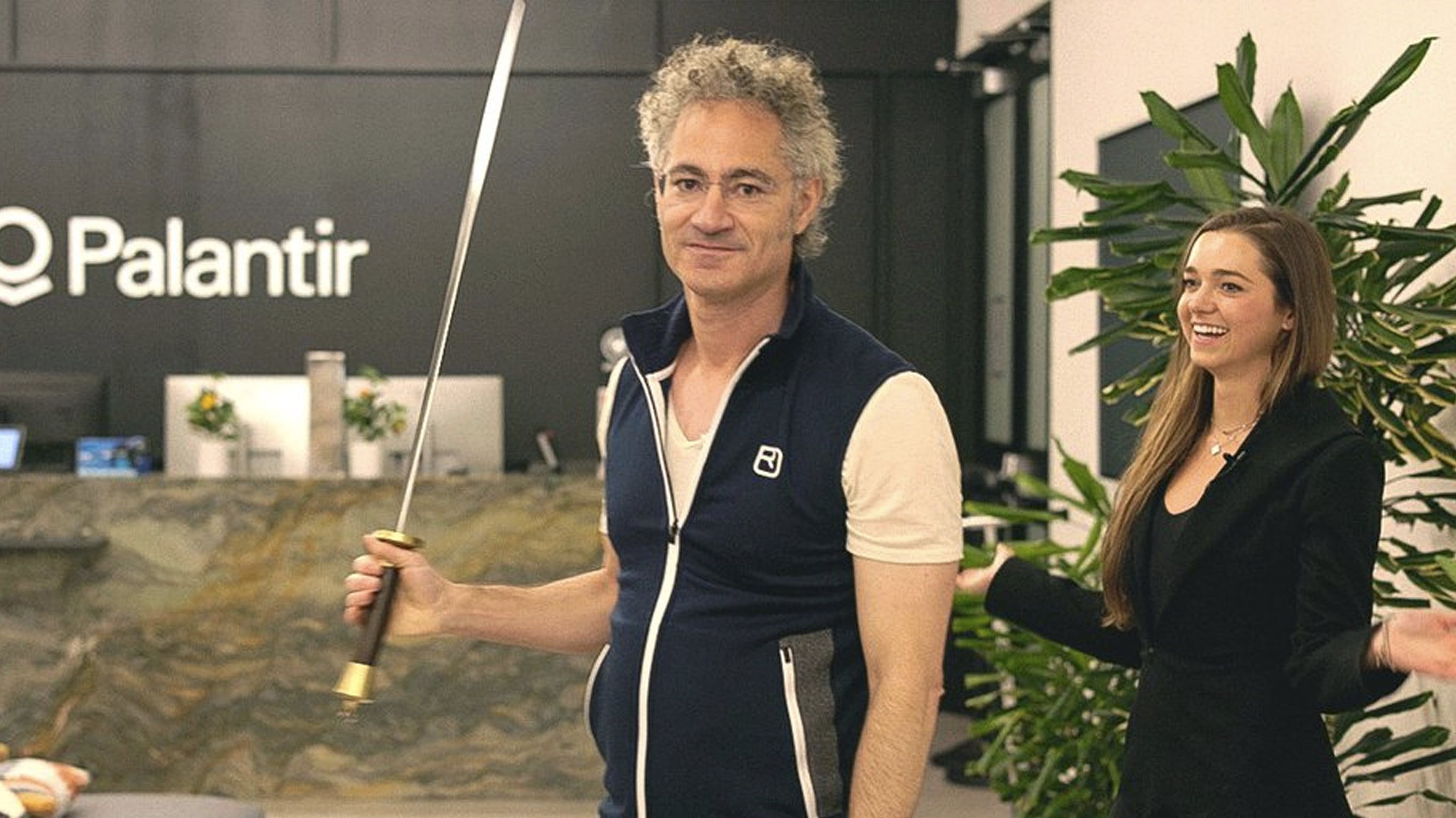
"Uh... Palantir is here to disrupt, and make our- the institutions we partner with the very best in the world, and, when it's necessary, to scare our enemies, and uh- on occasion, kill them, and we hope you're in favor of that, we hope you're enjoying being a partner, and we're really happy and very very focused on what we're doing."
Palantir and the people around them are... something. Every time Palantir has came up in a tech or political conversation recently, I've found that the person that introduces them gives a completely new blurb containing all-new info and atrocities that they're responsible for. You would think that, with the amount of research I've done for this site and the amount of political tech creators I follow I would've heard it all by know, but I still find myself learning more about Palantir and their prominent founders, Peter Thiel and Alex Karp. This is not to say that it's the fault of the people bringing them up in conversation. They are extremely hard to pin down. Extremely unique. Extremely secretive. Extremely powerful. My goal with this post is for it to be the be-all, end-all, long-form description of Palantir and their founders for people who stay up to date with tech and politics so people in the tech and political spheres can skip introducing them for the thousandth time.
What they've done
"Our product is used, on occasion, to kill people."
You would think that the most obvious question that I would seek to answer first would be what exactly they do. The problem is, we... don't really know? Like I mentioned before, every introduction of them brings a new explanation of how they've become so prominent. I wish I could give a simple one sentence answer as to what they are, but it just isn't feasible. One former employee said that "even as someone who worked there, it's hard to figure out" (Haskins). Rather than explain what they do, I think it may be easier to first share some things they've done.
Their primary dealings are their mysterious surveillance database systems for corporations and governments that we'll talk about in more detail later (Haskins). Palantir and their CEOs fund and work with everyone and everything including ChatGPT, ID verification companies, Israel, defense contractors, Amazon, young people's blood, Google, and anything else that could make them a profit or serve their interests (Harris, Gioino, Bamford, Rosenberg, Bercovici, Heilweil).
Their government customers include the US and Israel. They work with just about every facet of the US government under both parties, including ICE, the Pentagon, the military, and even the USDA (Allen, Feng and Stanley, Jeans, Subin, Subin and Moody). They've been working with ICE since the Obama administration (Allen). Under Project Maven, they help the military accelerate their "kill chain" via AI (Lewis-Kraus). They're helping Trump create a database of every American (Rashid, Frenkel and Krolik). They are proud of their tech being used to place drone strikes, including strikes on civilians, in occupied Palestine and in partnership with Ukraine (Hurwitz, Eby, Khomenko, Bamford). Their tech was used in Israel's 2024 pager attack (MEE). They even work with the United Nations' World Food Programme (WFP). They are involved in governmental lobbying to the greatest degree (OpenSecrets, TTP). They develop ELITE, an app that ICE uses in order to determine what neighborhoods to raid next (Cox, Richman).
Their corporate customers including everything from health insurance, Wendy's, Beyond Meat, Anheuser-Busch, John Deere, the AARP, Wells Fargo, Walgreens, BMW, American Airlines, AT&T, Fox News, ExxonMobil, Pray.com, and much more (Business Wire, Purge Palantir). Practically any big tech company has some form of tie to them (Haselton, NVIDIA). They've integrated with Amazon, Google, Oracle, NVIDIA, Meta, Anthropic, xAI, OpenAI, and more (Amazon, Palantir, Gordon, Oracle, NVIDIA, Spatacco, Palantir, Palantir). They arm the US government alongside Google and Anthropic with AI and Claude, and with Microsoft to provide cloud computing and data tools (Heilweil, Bracken, Microsoft, Microsoft). They've built an AI OS with Dell to be used by "the paranoid" (Markoch, Dell). Health tracking ring company Oura uses their tech in their defense sector work (Ramsey, Parmar).
Their crazy stock prices only continue to rise higher and higher (Yahoo, Trefis, Trefis). They pay influencers to promote pro-American, anti-Chinese AI (Lorenz). Their founders and CEOs are... interesting... which we'll talk about later, and they have incredible amounts of influence within the world. For example, Peter Thiel started a secret society with government and corporate officials as members, is largely the reason JD Vance is where he is today, and Jeffrey Epstein used his connection with former Israeli Prime Minister Ehud Barak to meet him.
Palantir is a company that... uh...
"If you're evil, you're at least competent. Um... and if you're evil, you're not bad. And therefore you're actually... maybe you're actually kind of... kind of good because you're at least getting something done."
So, what do they do then? The most common, general explanations are some form of "they provide a surveillance database to groups like the US and Israeli governments" or that they "sell purchased private data to the government", but those aren't entirely accurate. It's closer to "they provide a database and system connection surveillance system for private and government groups". Their sales pitch says that they can replace dozens of other internal data systems with just one - theirs. Their main two products - Foundry for commercial and Gotham for government - allow different internal systems and databases - whether they were deployed in the 1960s or the 2020s - to connect in such a way that can help with things like investigations, inventory, or killings. They do not provide any of the data for their systems, that is brought in by the customer. They also have Apollo for software updates and a plethora of AI integrations. Even Palantir themselves have trouble explaining themselves to interested parties. They've had to make multiple blog posts to clear up confusion about what they are. One former employee said they do "really extravagant plumbing with data" (Haskins).
So why is defining Palantir so hard? Perhaps it's intentional. The less people know about them the harder it is to oppose them. They don't really need to advertise to potential customers that much like most companies do - their employers are governments and other giant corporations. The less the masses know about the surveillance state, the better.
When attempting to describe Palantir for Wired, Caroline Haskins describes them similar to how the Super Soldier Serum in the Marvel movies is explained. Palantir makes whoever wields their products stronger, while amplifying their biases. If a group was morally bad before, Palantir will make them worse (Haskins).
In summary, they further the surveillance state by helping governmental and corporate bodies to connect and enhance existing data flows while helping military groups to do their killings. Parts of their dealings may sound almost harmless, but when you remember that they deal with everything from ICE's concentration camps and deportation efforts to the USDA to big tech to lobbying, they are pretty frightening. What makes them even more frightening is the motivations, people, and interesting founders behind the company.
The People
"I created Palantir and hired a huge number of my smartest friends to work together to save Western Civilization from our adversaries, especially communists and Islamists, while also reducing waste and fraud, and preserving civil liberties."
See the relevant entities' Wikipedia articles for more information and sources. Believe it or not, this was the brief version.
Palantir was founded in 2003 by five people:- Paypal co-founder, transhumanist, gay conservative, Antichrist lover Peter Thiel
- anti-woke, "socialist", techno-nationalist Alex Karp
- pro-public execution conservative and former Paypal intern/venture capitalist Joe Lonsdale
- computer scientist and former Paypal exec Stephen Cohen
- former Paypal engineer Nathan Gettings
They get their name from the all-seeing stone (not unlike their products) in the Lord of the Rings, and from Thiel's name (Greenberg). Nowadays, Thiel is chairman, Karp is CEO, Cohen is president, and Lonsdale is merely an advisor (Au-Yeung). Practically nothing is known about Cohen or Gettings' personal lives or beliefs, and not much is known about Gettings at all past his name and that he supposedly founded the company - he doesn't even have a Wikpedia article. With the exception of Gettings due to the lack of information, they are now all billionaires (Sloan and Carson). Of the five, Thiel, Karp, and Lonsdale are the most interesting.
Peter Thiel

"Uh... yeah, well, I... I don't know... I... I would... I would... um..."
Thiel's philosophy and political standpoints are complicated, unique, often contradictory, and in-depth. He is gay, conservative, libertarian, and transhumanist (transhumanists believe in shedding our material forms through the enhancement of the human body using technology, hence the human race enduring quote) (Wiener, Douthat). Much of his philosophy could be seen as being muddled with contradictions, like with him being a gay conservative, being anti-democracy but being a backer of the Alliance of Democracies Foundation, being one of the Republicans' biggest recent donors and supporters but leaving the US for Argentina over fears of how the US is heading, supporting conservative family values while being an associate of Jeffrey Epstein, and more (Seidelin, Schwartz, Bubola and Mac, Petti).
Peter Thiel was born in Germany, before moving to California when he was one. Until he was 10, he lived in an apartheid South Africa town called Swakopmund where, at the time, people regularly flew Nazi flags and greeted each other will "heil Hitler" (O'Dea and GHI, McGreal, Kamm). During his time studying philosophy at Stanford, he founded the university's conservative/libretarian news publication. Lonsdale was an editor-in-chief (Wallace-Wells, Fish). He also met Karp during his name at Standford (Steinberger). He worked as a law clerk in the US eleventh District of Appeals (Roberts, Walsh and Grim). From this point on, he became a founder and investor.
As the "don" of the Paypal Mafia, Thiel got his start during the dot-com bubble as a co-founder of of the platform in 1998, alongside Elon Musk and others (Forrest). Early on, they received investments from Nokia and Deutsche Bank (Koetsier). He was the CEO until they were bought by eBay in 2002 (Lien). Using the wealth he accrued while at Paypal, he founded the hedge fund Clarium Capital in 2002 where Thiel, Karp, Cohen, and Lonsdale all worked together (Britannica, Steinberger, MarketScreener, Vance). In 2003, Palantir was founded (Wexner).

In 2004 Thiel became the first investor in Facebook, where he served on the board until 2022. He became close to Mark Zuckerberg, which whom he bought a car for (Cao, Feiner and Levy). If you've seen The Social Network, maybe you remember his appearance as the critical investor that got Facebook their new office before their 1 millionth user (Fincher). In 2005, he started venture capitalist firm Founders Fund (Mann). It was at this time when Thiel's investment portfolio really started to grow, reaching many companies you've likely heard of and dealt with. Flock Safety, Airbnb, Nintendo's Pokémon Go creator Niantic, LinkedIn, Spotify, SpaceX, Stripe, DeepMind, ResearchGate, Anduril, Persona Identities, GoodRx, Oculus, Musk's The Boring Company, Affirm, Polymarket, Credit Karma, Brave, and so, so much more (Flock, Parloff, Levy, Shead, Kroker, Roof, Empson, Griffith, Bellan, Redrup, Clark, Kincaid, Perez).
"peter thiel LOVED the secret socieity idea. . he has done alot of work on the concept."
In 2006, Thiel and Auren Hoffman founded Dialog: an invitation only, off the record, "private" society for elites and oligarchs that hosts retreats for it's members (Allen). The organizers include Karp, Palmer Luckey, and Elon Musk and, due to very very poor cybersecurity, it was revealed in 2026 that attendees include Lonsdale, US senators Cory Booker and Ted Cruz, Maryland Governor Wes Moore, former and current Trump Cabinet members Julián Castro, Scott Bessent, and Tulsi Gabbard, journalist Ezra Klein, former Google CEO Eric Schmidt, LinkedIn co-founder Reid Hoffman, Trump's son-in-law and offical Jared Kushner, a Property Brother, and many more extremely powerful and wealthy figures (Cameron and Almazova, crimew). Epstein was forwarded an invitation in 2012 (DOJ, Jmail). They held talks, like "Build-a-Cult" by the founder of Pray.com, "Build-a-Party" by a former White House national security official, "Money (Does?) Buy Happiness", "Navigating WWIII", and "How's Your Sex Life?" (Cameron and Almazova, crimew). Thankfully, though, they arrested Epstein - so we don't need to worry about any more secret oligarchical pedophilic cabals. Booker and Cruz's government is very trustworthy, and politicans like JD Vance have nothing to do with Thiel. We're all good now.
"Peter's talk remains the most significant moment of my time at Yale Law School."
After a 2011 talk at Yale, Thiel met future Vice President JD Vance (Saul). Vance would later work for one of Thiel's companies before Thiel bankrolled his rise to power with multiple large donations to his Senate campaign, totaling over $15 million (Schwartz, McBride, Dwoskin et al.). Vance has been described as "the creation of one man" - that being Thiel. Thiel was responsible for his conversion to Catholicism, despite Thiel not being Catholic (Duran).
In 2011 he was given New Zealand citizenship by the Minister of Foreign Affairs in a private ceremony, despite not meeting the requirements (Nippert and Cook). Under Thiel Capital, also founded in 2011, he invested in billion-dollar scam FTX, conservative period-tracking app 28.co, and more (Rollet, Denton, Baker). He's invested in Praxis and the Seasteading Institute, which aim to bring about corporate-owned/autonomous city-states (Farooq et al., Levy and Ulmer, Madrigal). Together with Mark Cuban and Marc Andreessen he backed a crypto investment fund (Chainwire). He invested in or otherwise backed Quora, Reddit, Vivek Ramaswamy's financial firm, Sam Altman's Hydrazine Capital, anti-aging tech, and JD Vance's Narya Capital (Tsotsis, Cook, Bell, Hagey, Davidson, Kinder et al.). In 2014, Jeffrey Epstein used his relationship with former Israeli Prime Minister Ehud Barak to meet Thiel (Petti). Thiel has met and worked with Epstein on numerous occasions since, like with Thiel turning his $40 million investment into $170 million (Confessore, Goldstein). In 2015, Sam Altman met his now husband "in Peter Thiel's hot tub at 3 a.m." and Thiel became one of the main investors in the newly founded (by Altman) OpenAI, creators of ChatGPT (Hagey, Priestly). Also in 2015, he, along with Zuckerberg, Musk, Hoffman, and more, had a dinner with Epstein (DOJ, Jmail, Bouris, Teves). He became the lead funder of the Enhanced Games (Ostlere). Trump promised him a spot on the Supreme Court (Roberts, Walsh and Grim).
In 2017, Thiel married his long time partner - former former vice president of BlackRock Matt Danzeisen (Primack and Allen). They have multiple kids together (Adeaga). Danzeisen is more secretive; not as much is known about him. He and Thiel are rarely seen in public together (Chafkin). At the beginning of the pandemic, Thiel entered a relationship with gay model Jeff Thomas, which Danzeisen reportedly knew about. Thomas wasn't a fan of Thiel's right leaning politics. He worked with Democratic researchers and reporter Ryan Grim to share damaging information about Thiel. After a public fight at a party between Thiel, Danzeisen, and Thomas, Thomas was found dead in his apartment building - ruled a suicide (Grim).
He became an FBI informant in 2021 (Scwartz). He has been an interest of Russian intelligence (Kirchgaessner). He was one of the largest donors to Republicans in 2022 (Schwartz). After he hired a former Austrian Chancellor, he got a song made about him depicting Thiel as a James Bond villian (which I found quite funny) (Leadersnet, ZDF). Palantir became a strategic partner of Israel in 2024 (Newman).
He is on the board of directors for a uranium production and handling company (Operle). He founded America's Frontier Fund alongside former Google CEO Eric Schmidt (Livni). Thiel has been the mentor for multiple prominent figures, including Lonsdale, Zuckerberg, Altman, (now Meta-owned) Oculus and defense contractor Anduril founder Palmer Luckey, and through the Thiel Fellowship in which he pays students to drop out of college (which he was inspired to create after seeing the portrayal of himself in The Social Network) (Hartung, Clynes).
He has long been interested in topics like the Antichrist and Armageddon, even giving speeches on the topic (Chafkin, Christian Post). He believes people like Greta Thunberg to be "legionaries" of the Antichrist (Bhuiyan). In 2026, Thiel and his family moved to Argentina motivated by concerns over the direction that the US is heading - which he is at least partially responsible for - following relations with the anarcho-capitalist and similarly libertarian president Javier Milei, who believes that his dead dog told him that God wanted him to be President of Argentina (Bubola and Mac, Guzman).
Alex Karp
_4-5_ratio.jpg "Image showing Alex Karp")
"I spend a lot of time talking to Nazis, like, real Nazis."
While comparably less is known about Alex Karp, he is almost equally as interesting and has just as many contradictions as Thiel. He's in a relationship with two women, but he's "geographically monogamous" (Steinberger). He says he is a socialist (Robinson). He's a billioniare (Bloomberg). He owns 11 houses (Berg). He espouses Western and US propagandic rhetoric. He is the moral center that Palantir supposidly grounds itself on (Steinberger). He thinks war crimes should be legal (Wilkins). He leads Palantir to have "a consistently pro-Western view, [as] the West has a superior way of living and organizing itself" (Dowd). He's progressive "but not woke" (Dowd). He's a zionist (Koller). He believes in mandatory military conscription (Dowd). He says tech companies have an obligation to help the US military (Sorkin). He was the first major Western CEO to meet with president Volodymyr Zelenskyy after the invasion of Ukraine (Dowd). Again, remember he's a socialist. If you couldn't tell, he has an "idiosyncratic personal definition in mind that has nothing in common with the socialist tradition" (Robinson).
For me, he brings to mind the National Socialist German Workers' Party - better known as the Nazi Party - in the sense that he calls himself a socialist but his actions don't reflect that whatsoever. The Nazis were by no means and to no extent socialist. It may be more of a marketing thing for Karp, like it was for Hitler (Ray and Britannica). It's fitting, considering he says he frequently speaks with Nazis (Landymore).
"I love the idea of getting a drone and having light fentanyl-laced urine spraying on analysts who try to screw us."
Joe Lonsdale

"If I'm in charge later, we won't just have a three strikes law. We will quickly try and hang men after three violent crimes. And yes, we will do it in public to deter others. Our society needs balance. It's time to bring back masculine leadership to protect our most vulnerable."
In comparison, Joe Lonsdale isn't as ideologically interesting. He's a rich billionaire venture capitalist. He says we should publically hang criminals and "blow up" communists (Blum, Lonsdale). In fact, he says blowing up communists was exactly why Palantir was created (Duran, Pabst). Unrelated: seems like Karp is doing a great job as the moral center. He had a long battle with a sexual assault accusation from a former lover that he met at Thiel's Stanford Review (Levine and McBride). He's a self-described contrarian: all he wants is to be against someone (Bort). He's a big Republican donor (Abraham, Burns). He said he joined the FDA to "accelerate the [their] latest AI initiatives", which the FDA denied (Schumaker). He founded the University of Austin alongside Bari Weiss and others, which he's described as a sanctuary from the "woke mind virus" and "radical, far-left ideologues" (Gillespie). He founded a conservative think tank that pushes for criminalizing homelessness and pushes against the idea that everyone deserves a home (Abraham, Burns). I mean, can anything even suprise you anymore?
Conclusion
One thing that I believe makes them unique among tech and government-contracted companies is their ideology, in that they have one. When you think about similar companies - Google, Amazon, Meta, Lockheed Martin, Boeing, etc - they aren't trying to do anything other than gain money and power. Google, Amazon, and Meta change party allegiances in a way that conviently matches who's in the White House at the time. I don't know much about Lockheed and Boeing's inner workings, but I do know they don't post manifestos arguing about how the West needs to exert its' power or bloat about how their tech spies on and kills people. None of them really have an ideology, other than the service of profit and whatever the current administration of Empire wants it to be. Palantir, on the other hand, very much does have an ideology. A confusing one, a contradictory one, sure, but it's an ideology nonetheless.
They recently released 22 bullet points that supposedly guide them. Some notable points include "the postwar neutering of Germany and Japan must be undone", "Silicon Valley must play a role in addressing violent crime", "some cultures have produced vital advances; others remain dysfunctional and regressive", "the limits of soft power, of soaring rhetoric alone, have been exposed", "if a U.S. Marine asks for a better rifle, we should build it; and the same goes for software", and "we must rebel against the tyranny of the apps" (Griffiths).
I hope it is at least slightly more clear what Palantir and the people behind them actually do, although realisitcally it probably isn't. I'm not sure if it can be. They're just so weird. They're involved in so much. I mean, they were founded cooperatively by a socialist and a gay conservative in order to spy on and kill people. Can't get much weirder than that. But, sadly, they're powerful and important, so we have a duty to learn. Hopefully now we can start to skip their introduction whenever they come up in headlines from now on.
Check out Purge Palantir for more information and advocacy against their insanity.